

I would like to express special gratitude to Dima Milevich, who first recommended Huxley's book "Island" to me, and then shared Alan Watts. Thank you! :)
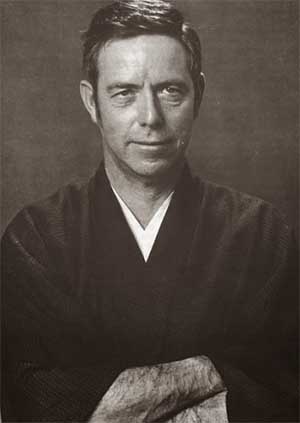 Alan Watts (1915 - 1973, England) — a guide into the world of Eastern philosophy, a lecturer and scholar, but primarily he is a "bodhisattva," which means "a Buddha who has returned from seclusion to the world of people." I'll say right away that this is my last serious discovery, and one of the most productive. It was precisely the acquaintance with the ideas of Buddhism, Taoism, as well as their synergy, Zen Buddhism, that gave me some of the richest material for realization and laid the foundation for fruitful ideas. I mentioned Eastern philosophy when talking about Huxley's "Island" — it was this book that showed me the possibility of implementing certain Indian ideas and practices in a small society. When I wanted to get to know more, I was recommended Alan Watts, a student of Dr. Suzuki — the main introducer of the East to the West in the 60s, 70s, and 80s of the last century. Watts throughout his life was both a priest in a Protestant church and a Zen monk-student in Japan. Understanding Western religion, and consequently Western thinking, in synergy with deep familiarity with the Eastern world and a storyteller's talent gives an amazing result. It was this man, sometimes harshly, sometimes gently, but always creatively and methodically, who explained to me points of perceiving the world that had been hidden until then. He traveled the world for years, mainly the States, and gave lectures on Zen Buddhism, Taoism, Buddhism, Eastern ways of thinking in general, traps of Western thinking (analytical structure of language, dualism, ego, fixation on words), lectures dedicated to such aspects of reality as space and time, life and death. Most of these lectures were recorded and are now available for listening on YouTube or as audiobooks.
For acquaintance, I advise starting with the audiobook "Thusness" — a kind of intro to the historical context of Eastern worldviews. For listening, I use the Scribd app on my phone. Watts also had print books; I read his main work "The Way of Zen", as well as the book "Nature, Man and Woman". If further interested, ask me :)
I hasten to note right away that I have quotes only from the print versions of his works. All his audio lectures can be pulled apart into quotes literally by sentences, but I haven't done that.
Quotes
The Way of Zen (1957)
Names and terms must, by necessity, like any unit of measurement, be defined and fixed to fulfill their purpose. But they handle their task so well — in a limited sense — that man is constantly tempted to confuse these measurements with the measured world, to identify money with wealth, a fixed convention with changing reality. However, to the extent that he identifies himself and his life with these rigid and empty definition-templates, he condemns himself to the constant disappointment of one who tries to carry water in a sieve. Therefore, Indian philosophy tirelessly reminds us how foolish it is to chase things, to demand permanence from individual beings or phenomena — in all this it sees only blindness to phantoms, enchantment by abstract measures of 'mind' (manas).
Hui-neng considered that a person with an emptied consciousness was no better than "a log or a stone." He argued that the very idea of purifying the mind is absurd and false, because "our own nature is fundamentally pure and transparent." Hence, there can be no comparison between consciousness (or mind) and a mirror that should be wiped. True mind is 'no-mind' (wu-hsin) and cannot be considered as an object of thought or action, as if it were a thing that could be seized and controlled. Attempts to improve one's own mind lead to a vicious circle. Efforts to purify it — to the contamination of purity. It's clear that before us is the Taoist philosophy of naturalness, according to which a person cannot be truly free, pure, and unattached if their state is the result of artificial discipline. The purity of such a person is fake, their clear consciousness is deliberate. Therefore, such people are full of unpleasant self-satisfaction — a typical feature of conscious and methodical religiosity.
Nature, Man and Woman (1958)
To hear what others say, a person must be silent. In the same way, the human mind must be silent to comprehend something different from its thoughts.