
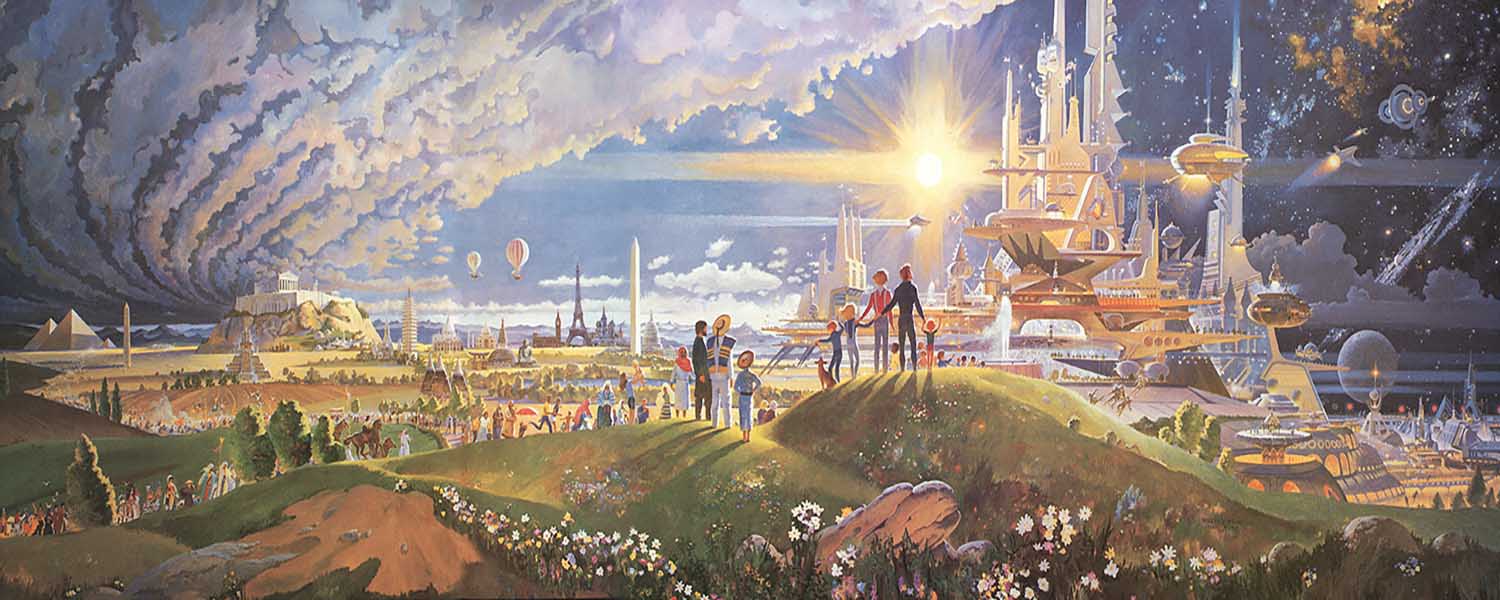
The constellation of authors mentioned below became famous for their surgically precise operations on the structure of their contemporary society in order to show wrongnesses and unnaturalness, as well as to point out where this leads and how it will look in the future. Each of these gentlemen did this in their own way. Getting acquainted with such work is a good push for forming a picture of society. Each of the realities they described is more or less similar to ours; there is something to learn from each of these authors.
Ray Bradbury (1920 - 2012, USA)
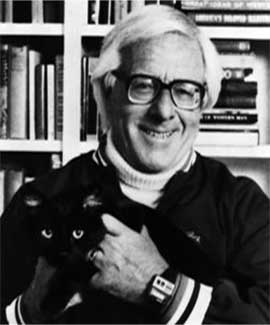 Bradbury cannot be called a classic dystopian, for his creations varied in different ranges: from tender summer romance that wonderfully transports you to childhood (Dandelion Wine) to collections of magical stories about short urban incidents (The Martian Chronicles). As for his critical view of the possible future of the world, he embodied it in the book "Fahrenheit 451". The novel describes a future where books are burned because they cause thought processes, and this is undesirable in a world where society is controlled through the absorption of entertainment, and people spend all their time in rooms where instead of walls there are huge television screens. Sharp and atmospheric, the novel develops gradually but soon picks up speed. Bradbury definitely influenced me in childhood: I read him around age 10. His books are overflowing with kindness and understanding of what is truly important: grandmother's touch, sun on your cheek, a favorite path in the forest, books not TV, feelings not mindless entertainment.
Dandelion Wine (1957)
The first thing you learn in life is that you're a fool. The last thing you learn in life is that you're the same fool.
Fahrenheit 451 (1953)
It's hard to say exactly when friendship is born. When you pour water drop by drop into a vessel, there is one last drop from which it suddenly overflows, and the moisture spills over the edge; so too here, in a series of kind acts, one suddenly overflows the heart.
Organize various contests, for example: who best remembers the words of popular songs, who can name all the main cities of the states, or who knows how much grain was collected in Iowa last year. Stuff people's heads with numbers, fill them with harmless facts until they get sick; they'll think they're very educated. Spin the human mind in a frantic whirl, faster, faster! — with the hands of publishers, entrepreneurs, broadcasters — so that the centrifugal force throws out all the unnecessary, useless thoughts!..First of all work, and after work entertainment, and there's plenty everywhere, at every step, enjoy! So why learn anything except how to flip switches, tighten nuts, fit bolts? It wasn't through prescriptions that this began, not through orders or censorship restrictions. No! Technology, mass consumption — that's what led to the current situation.
Kurt Vonnegut (1922 - 2007, USA)
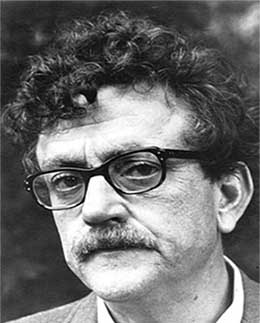 Kurt Vonnegut for me is something like impressionists among painters: non-standard manner of presentation and surrealistic plots. In the book Player Piano, Vonnegut speculates on the theme that in the future the most important decisions will be made by machines, and people and their creativity will become unimportant elements of an already functioning system. Cat's Cradle — the second thing I read — essentially constitutes a collection of aphorisms and wisdom, expounded by some island thinker. Each chapter of the book begins with another idea about how the world works (in a rather peculiar form). At the same time, there's a plot tangentially related to this island sage, but invented seemingly just for the sake of it. Vonnegut's books abound with humor and touch on controversial ideas. His main characters, from whose perspective the narrative is conducted, are endowed with rich imagination and are not strangers to irony. The author's excellent sense of humor is one of the reasons to get acquainted with his books.
Cat's Cradle (1963)
Peculiar travel suggestions are dancing lessons from God.
Yevgeny Zamyatin (1884 - 1937, Russia)
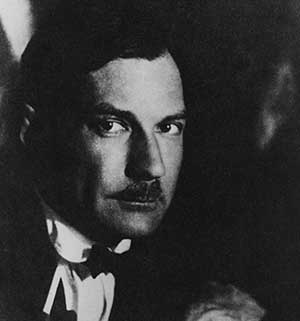 Yevgeny Zamyatin - We. I definitely remember that this book was part of the school curriculum and that's how I learned about it. If I could draw, I would much rather draw what I think about this book than put it into words :) Nevertheless, I'll try: it's the brightest, blindingly bright, cry against the idea of the Soviet Union in the sense of killing individuality, it's the strongest flow of thoughts and feelings, casting an incandescently white beam of light on the terrible and unnatural state of affairs that was preparing to take shape in the country (Zamyatin wrote the novel in 1920). "We" leaves a very strong impression and is especially relevant for us, the descendants of that system. This novel describes a society of rigid totalitarian control over the individual (names and surnames are replaced by letters and numbers, the state controls even intimate life), ideologically based on the exaltation of science and the denial of fantasy.
Your case is bad! Apparently you have developed a soul.
— doctor at the Medical Bureau
Soul? This is a strange, ancient, long-forgotten word.
— D-503
George Orwell (1903 - 1950, England)
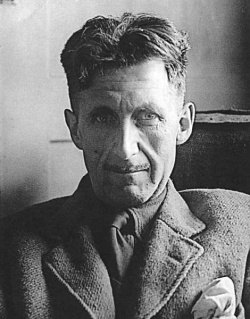 Orwell. Perhaps the most famous of the dystopian authors; he was inspired by Zamyatin. The idea of "Big Brother," always watching you, is the fruit of his labors. Orwell saw the future of the world in totalitarian colors: people's thoughts are strictly controlled by mass media subordinate to the state, universal surveillance and informing, the impossibility of the existence of an alternative point of view, rewriting of history, distortion and alteration of facts, in short, a kind of picture of the Soviet system (and not only Soviet, isn't it?). People capable of a critical view are immediately either recruited on terms of blackmail and threats, or simply destroyed. In such a society, human freedom is denied and persecuted, reduced to nothing by global dictatorship. The novel "1984" is a description of a future built on the above-described postulates. The main character works in the so-called Ministry of Truth (the name alone gives an idea of the state of affairs), and as the book progresses, he begins to realize the horror of the system and desire changes, while continuing to pretend to be an ideological follower of the regime. Big Brother is depicted as a black-mustachioed middle-aged man, and in him one easily recognizes a prototype of Stalin. Another famous novel by the author - Animal Farm - is a stunning, irony-filled allegory of the events of 1917 and the subsequent political situation. Only the characters of the book are animals. Again, George masterfully criticizes stupidity, lust for power, violence, and other idiocy.
Animal Farm (1945)
All animals are equal. But some animals are more equal than others.
1984 (1949)
The best books tell you what you already know yourself.
War is a way of shattering to pieces, dispersing into the stratosphere, sinking in the sea depths materials that could improve people's lives and thereby ultimately make them smarter.
Aldous Huxley (1894 - 1963, England)
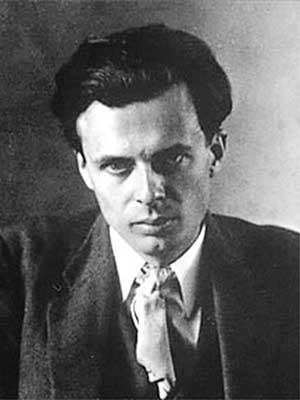 Aldous Huxley was a representative of the upper class of England, the elite. The Huxley family on both sides for centuries produced outstanding scientists, writers, and public figures. While studying at Oxford with a major in English Literature, Aldous was part of the famous Bloomsbury Group, which inspired and included such people as Keynes, Moore, Russell. The group was based on the rejection of bourgeois values; its members preached pacifism, humanism, developed views on women's place in the world, as well as sexuality. Huxley graduated from the university with the highest diploma, after which he was immediately offered a professorship (!), which he refused, citing the one-sidedness and limitations of England's educational system. Throughout his life, Aldous wrote dozens of scientific works and essays in various fields, but mainly advocated for pacifism, universalism, humanism, and in the second half of his life, he interwove elements of Eastern philosophy into his work, was interested in Vedanta and mysticism. The work that brought him worldwide fame, "Brave New World", remains unread by me for now (although the main idea is clear), whereas the books that influenced me were "Point Counter Point", "The Doors of Perception", and "Island".
Point Counter Point (1928)
"Point Counter Point" is a masterful cross-section of English high society, a book permeated with irony and outright mockery of the manners and thoughts of Huxley's milieu. The story is told from the third person, or rather persons, each of which is a specimen of one or another weakness: stupidity, vanity, lust, corruption, laziness and boredom, cowardice or sycophancy... you name it. It's amazing how all these characters, different in form, have one common root called personality. Each of these corrupted people is a perverted version of themselves. This vice is a trait of pampered society. The funny thing is that while reading the book, I found pieces of myself in each of these people. Our task is to get rid of these pieces, which essentially only spoil our lives; Huxley skillfully draws a map by which we can and should walk.
"Nobody's asking you to be a bull or a dog," said Rampion irritably. "You're only asked to be a man. A man, understand? Not an angel or a devil. Man is an acrobat on a tightly stretched rope. He walks carefully, trying to keep his balance, holding a pole with consciousness, intellect, spirit on one end and body, instinct, and all that is unconscious, earthly, incomprehensible in us on the other. He tries to keep his balance. It's devilishly difficult."
If people satisfied their instinctive needs only when they actually felt them, like the animals you so despise, they would behave a thousand times better than the vast majority of civilized human beings. Natural needs and immediately arising instinctive desires would never make people such beasts — no, "beasts" won't do: why offend the poor animals? — such too-humanly bad and vicious creatures. What makes them so is imagination, intellect, principles, tradition, upbringing. Leave instincts alone and they won't harm you. If people indulged in love only when passion seized them, if they fought only when they were angry or frightened, if they clung to their property only when they really needed it or were seized by an irresistible desire to possess something — I assure you that then the world would be much more like the kingdom of heaven than now, under the rule of Christian-intellectual-scientific liberalism. You think instinct created Casanova, Byron, Lady Castlemaine? No, instinct has nothing to do with it: it was their lustful imagination that spurred their needs, generated desires that would never have naturally arisen in them. If the Don Juans of both sexes obeyed only their desires, they would have very few romances. They have to artificially heat their imagination, otherwise they couldn't sleep with whomever and whenever. The same with other instincts. If modern civilization is going mad over money, the instinct of possession has nothing to do with it. Education, traditions, moral principles artificially excite it. Greed for money appears in people only because they are convinced that this greed is natural and noble.
The instinct of possession was never strong enough to make people chase money from morning to night all their lives. Imagination and intellect have to constantly spur it on. And think about war. It has nothing to do with spontaneously arising martial spirit. To make people go to war, they have to be compelled by law and spurred on by propaganda.
The Doors of Perception (1954)
In the second half of his life, Aldous moved to California, where he unfolded his most productive period. There are many reasons for this, for example, the climate and the generally pleasant Californian vibe of free spirit of those times, but definitely among them is his acquaintance with Indian teachings as well as the beginning of experiments with psychedelic substances, particularly mescaline, the active substance found in shamanic peyote cacti, or synthesized chemically in purer form. By the way, a psychiatrist participated in this experiment, providing the substance itself and also watching over the writer after taking it. Huxley described in detail his experience with mescaline in the book The Doors of Perception. I'll provide my translation of the author's own words: "The mystical experience is doubly valuable; it is valuable because it gives the recipient a better understanding of themselves and the world, and also because it helps them lead a less self-centered and more creative life." The book is short and quite curious. At the end, Huxley openly writes that the world would be times better and would get rid of all its problems if all people on the planet tried mescaline at least once in their lives. By the way, my dad's favorite band was named after this very book :)
Island (1962)
"Island" is the author's last book, in which influences absorbed by Aldous in California are clearly visible. Essentially, Island is the quintessence of how the author saw the right life and society. The book expresses his ideas on how a commune should be organized, how to raise children, attitudes toward love and sex, perception of the world, the educational system, and in general: how people can and should live. It's a utopia, opposite in meaning to his early book "Brave New World." The main character ends up on an island where people, thanks to the fruitful influence of certain individuals in the past and isolation from the wider world, have built an amazingly harmonious system and created wonderful living conditions, theoretically based on a kind of mixture of Buddhism, Hinduism, and a scientific approach. This book provides such rich food for thought, provokes the movement of thought so fruitfully, that ultimately it pushed me to study philosophy of a completely different kind: Eastern. But more on that later :)
Actual happiness always looks squalid beside the florid decorations of unhappiness. And, of course, stability isn't nearly as picturesque as instability. And contentment is utterly lacking the romance of battling fate, no colorful struggle with temptation, no aura of fateful doubts and passions. Happiness lacks grandiose effects.