
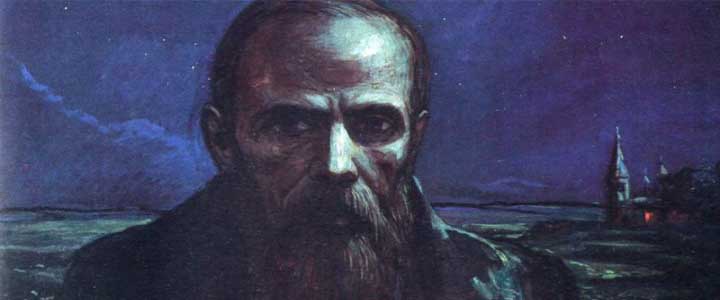
Fyodor Mikhailovich Dostoevsky (1821 - 1881) is a window into the soul of Russia. No one has peered so penetratingly, psychologically, and in such detail into the essence of the people and the country; he was a man who not only built a bridge of understanding of the common man for his educated contemporaries and descendants but also thoroughly analyzed and laid out how people think in Russia. There is perhaps no better guide for understanding and comprehending the Russian soul and land than this writer. However, the significance of his works can safely be expanded to a universal human level; he inquisitively and thoroughly penetrated behind the scenes of the human mind in a universal sense. His efforts were directed at Russia, of course it was the backdrop of his work. In Dostoevsky's books, the main events unfold in the heads, souls, and hearts of his characters; in Tolstoy, for example, there is much more direct action. But since these three main vessels of human essence have been mentioned, one cannot help but speak of the novel "The Brothers Karamazov". In my understanding, the main characters of this book, the three Karamazov brothers, represent absolute archetypes: of the heart (love, passion, women - Mitya), of the head (calculation, rationality, ratio - Ivan), and of the soul (purity, truth, goodness - Alyosha). The vicissitudes of their fates are described in a novel filled with passions, thoughts, feelings, the search for God and meaning in human life. The novel "Crime and Punishment", in turn, tells the story of one confused young man who decided to do away with one harmful, useless old woman, rob her, and thereby improve his situation. The canvas of this picture, as Dostoevsky loves, is the mind of the protagonist Raskolnikov, torn between two decisions: to kill the old woman or to spare her. The author paints the path of his lamentations and mental agonies through the palette of the idea "Am I a trembling creature, or do I have a right?" In other words, human morality itself is questioned, which Raskolnikov discusses with himself. For me, this book also perfectly shows (as does The Brothers Karamazov) how far one can go in one's thoughts and how meaningless and harmful it can be. Getting acquainted with Dostoevsky can be compared to an intensive immersion in psychology and psychiatry, which is very useful in itself. By the way, Nietzsche said that if he could learn understanding of the soul from anyone, it would be from Dostoevsky. In short, a must-read!
Quotes
The Brothers Karamazov (1880)
About RakitinWell, I don't kick him out because he's a clever man. He's very arrogant though. I just told him: 'The Karamazovs are not scoundrels but philosophers, all true Russians are philosophers, and you, though you've studied, are no philosopher, you're a peasant.' He laughed, so maliciously.
But God torments me. That alone torments me. What if He doesn't exist? What if Rakitin is right, that it's an artificial idea in humanity? Then if He doesn't exist, man is the chief of the earth, of the universe. Magnificent! Only how will he be virtuous without God? That's the question! I keep thinking about it. For whom will he love then, man? To whom will he be grateful, to whom will he sing the hymn? Rakitin laughs. Rakitin says you can love humanity even without God. Only a snotty little upstart can assert that, but I can't understand it. Life is easy for Rakitin: 'You should,' he said to me today, 'rather worry about expanding the civil rights of man, or at least about keeping the price of beef from rising; you'll render your love for humanity more simply and directly thereby than by philosophies.' I retorted: 'But you yourself, without God, will raise the price of beef if you get the chance, and will make a ruble on every kopeck.' He got angry.