
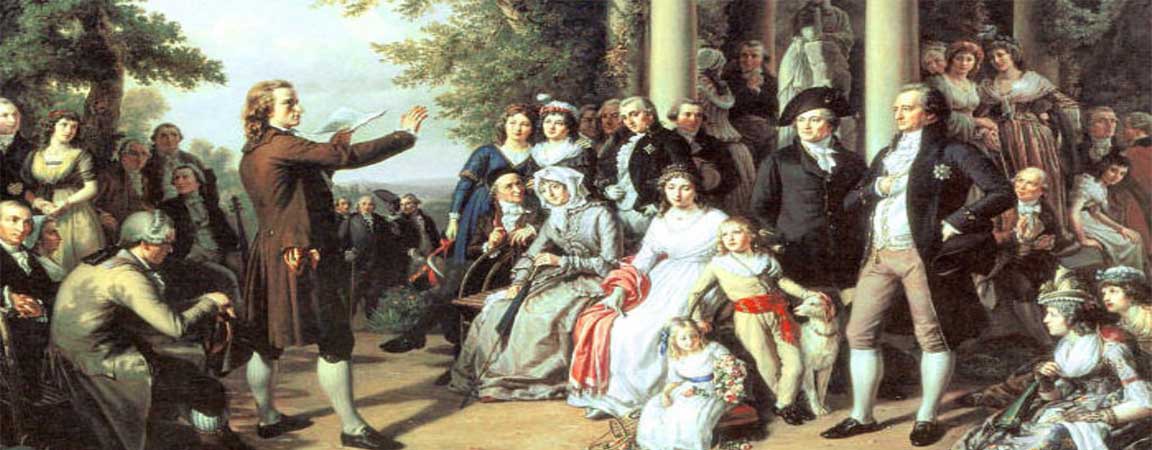
Immanuel Kant (1724 - 1804) - Critique of Pure Reason (1781)
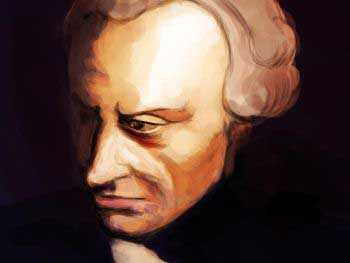 One of the flagships of the Enlightenment era, the founder of the German school of philosophical thought - Immanuel Kant. A professor, expert in many sciences, a person who sincerely believed in God. And, incidentally, one of the most terrible writers I have ever read :) According to history, Kant pondered his central book (Critique of Pure Reason) for more than 10 years but wrote it in 4-5 months, and it shows. Later he said that he needed to get everything on paper as quickly as possible.
His creation is an attempt to explain the world and construct a method of thinking on which any reasonable creative activity must be based, whether writing a philosophical treatise or a mathematical theorem. Kant creates a kind of system of reference points and rules of reason, by understanding and following which any diligent student can create their own philosophy (that is, in other words, put into words their understanding of the universe and man's place in it). At the cornerstone, Kant places a priori thinking: the concept that a person possesses some knowledge even before experience, that is, can know something without any possibility of verifying it through experience. Such a priori knowledge Kant calls transcendental and sets it in opposition to the empirical. Consequently, Kant divides human cognition into two camps:
1. Sensory cognition: engages the sense organs and is essentially a projection of objects of contemplation onto our brain.
According to Kant, sensibility cannot reveal things to us as they really are ("things in themselves"), but is formed only through (in the case of sight, for example) the contact of light reflected from an object with the retina of our eye, which then sends this image to the back of the brain, where the picture is formed.
2. Rational cognition: operating with primary categories, which Kant divides into 4 groups: quantity, quality, relation, and modality.
It is asserted that the 12 basic categories of reason are something cut off from direct sensory experience, yet still existing! In other words, we cannot show, for example, the quality of an object, yet it exists by itself and we understand this.
By dividing our cognition in this way, Kant makes it clear that intuition without thought is blind, and thought without experiential content is empty, and that reality lies at the intersection of the synthesis of feelings and reason. The same is proved by his conception of time and space as something completely immaterial and abstract, yet nevertheless being fundamental conditions of any experience. Moreover, Kant examines such concepts as analysis (division into parts) and synthesis (grouping of divided parts into something qualitatively new), both a posteriori (experiential) and a priori ("experience-free") manifestations of them. It is precisely at the foundation of reason that Kant places a priori synthesis, as a kind of ability of reason to synthesize concepts without experience before engaging in experience itself (mathematical theorems). Also, Immanuel examines the contradictions of reason, antinomies (by the way, thereby laying the foundation for Hegel's future dialectic). An antinomy is when a statement contains two meanings that contradict each other, but separately they are both perfectly logically provable. These contradictions arise when reason tries to go beyond the limits of experience and cognize things as "things in themselves," which is impossible. Kant identifies four main antinomies:
- The world is finite / infinite
- Everything complex is a combination of simple things / nothing is simple
- There is freedom in the world / the world is subject to causality ⇒ there is no freedom
- There exists a first cause of the world - God / there is no first cause
Kant believed that we do not cognize the world during sensory contemplation; I believe, on the contrary, that contemplation reveals to us the nature of things, since our brain, even without the participation of consciousness, understands everything perfectly and, if allowed, can teach us (this is sometimes called intuition). Moreover, to comprehend the essence of things, we do not necessarily need such categories as quality, quantity, or modality: classification is merely the division of the whole into parts in an attempt to better understand the whole, but by no means the only path to that whole. Reason is a verbal creation of our consciousness; it is excellent for analysis but not suitable for synthesis if taken alone. By reducing sensibility to the sense organs, Kant limits man to a kind of mechanism, and then places him in the eternal conflict of dualism: reason and feelings, thought and contemplation. Why? I see both of these processes as inseparable from each other and flowing from one another, but not as something isolated and requiring connection. One should keep in mind the historical context: Kant was a child of the Renaissance, an idealist, with one foot still standing in the philosophy of Christianity. Hence the ever-present dualism.
None of this makes Kant any less of a genius than he was. However, reading Kant is torture and mockery. Therefore, for familiarization, I recommend "Adorno T.W. Problems of Moral Philosophy. 1963" - a course of lectures by Professor Adorno. Lively, rich, interesting. And it also examines Kant's antinomies in detail, perhaps the most interesting proof of failures in the operation of reason.
Hegel (1770 - 1831)
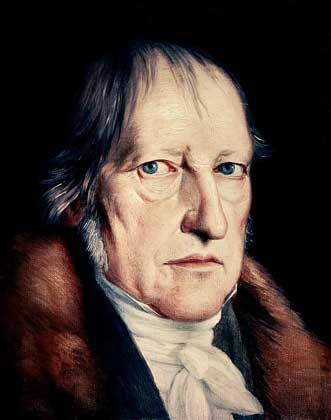 Based on Kant's methodology, Hegel formulated and fully expressed the science of logic, which found application in mathematics and, in general, became a powerful tool of thinking. He refined and modified Kant's categories. The development of Kant's antinomies sharpened his dialectic as "the universal method of cognizing contradictions as internal driving forces of the development of being, spirit, and history." Hegel understood dialectic as the only possible scientific way of understanding reality, where the process follows the scheme "thesis → antithesis → synthesis"; in other words, only through opposition can one arrive at truth. Hegel perfectly explains morality (a concept that is essentially controversial and smells of religion) not as some rules of the game laid down by God for people, but as a necessity following from rationality; this is essentially true, because when a person behaves as rationally and reasonably as possible, they automatically become highly moral, that is, they bring benefit to others because it brings maximum utility and benefit to themselves. Among other things, Hegel perfectly explains what true productive reflection is: the unique human ability at any moment to step "outside oneself" and look at the situation not just from the side, but from any possible point of view.
Hegel logically proves human freedom through the unlimited freedom of human will, or spirit. It's quite engaging to correlate his reasoning about human freedom with Eastern ideas about the world as a game where we are free to choose any roles, or not to choose them at all. In Hegel, this idea is similar to the idea of free human will subjugating reality to itself but having the ability to change direction at any moment.
For reading, I recommend Philosophical Propaedeutic - essentially a philosophy textbook for upper grades of the Nuremberg school, where he was director and taught. Consistently and much more understandably than Kant, Hegel introduces schoolchildren (and readers) to the basics of philosophy.
Schopenhauer (1788 - 1860)
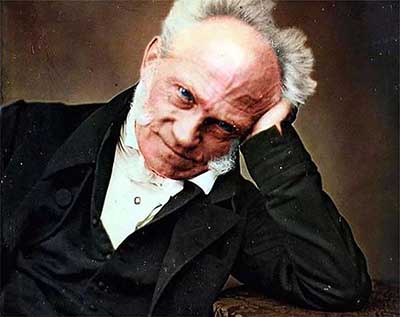 Schopenhauer was a talented follower of Kant. He took idealism to its final instance and partly resembled solipsists: Schopenhauer believed that our entire world is the fruit of the Representation of some universal unconscious Will, and incidentally - "the worst of all possible worlds." He couldn't stand people, and most of all couldn't stand women, which basically only proves his view of the world as a cold and meaningless "something." At the same time, being born into a privileged family, Arthur became acquainted with art early and also received an excellent education. His second favorite philosophy after Kant was the Indian Upanishads and Buddhism, and the idea of the world as a representation of some will (in Hinduism, the World is a dream of the God Krishna) clearly traces its roots to Eastern religions. However, upon closer examination, it becomes clear that Arthur did not fully accept these teachings, because his "universe" and "nature" were something otherworldly and unconscious in the sense of indifference, whereas in the East the world is a living and active quintessence of rationality in its divine majesty. Schopenhauer rejected Kant's morality, believing that at its roots it still nests in Christianity (which is basically true), and reproached Kant, for example, for completely ignoring animals, which he (Arthur) himself loved very much.
Despite the above-mentioned troubles and psychological complexes (like hatred of women), Arthur clearly understood the significance of art. He believed that philosophy (and he along with it) had taken the wrong path, seeking meaning in rationality when it should have been digging into art. He believed that a creative genius, through the creation of a painting or musical work, or anything else, is completely unaware of themselves and has not the slightest idea what they are doing, thereby allowing the universal Will to manifest itself to them. Thus, through their works, the creator creates a window to understanding the essence of things. When we look at such a creation (if we open ourselves to it), we are transported to the cognition of reality, and at this moment our "reason" is silent. I fully share this idea, and I have also found similar ideas in some other authors, for example, Aldous Huxley (especially in his book "The Doors of Perception," where he describes his experience with mescaline). Unfortunately, my acquaintance with Schopenhauer ended after several chapters of his book "The World as Will and Representation." Perhaps he seemed too abstruse and pessimistic to me, or maybe there was another reason, but the reading didn't appeal to me. I'm sure that with a more detailed study of him, it's quite possible to glean some new and interesting views; perhaps time and place must align, and in the future I will return to Arthur :). Nevertheless, I have repeatedly encountered references to his works and was able to form a certain picture of him and his work. If you still want to get to know him personally, I recommend, again, "The World as Will and Representation."
Quotes
Immanuel Kant - Answer to the Question: What is Enlightenment? (1784)
Enlightenment is man's emergence from his self-imposed nonage. Nonage is the inability to use one's own understanding without another's guidance. This nonage is self-imposed if its cause lies not in lack of understanding but in indecision and lack of courage to use one's own mind without another's guidance. Sapere aude! "Have the courage to use your own understanding," is therefore the motto of the Enlightenment.
Adorno - Problems of Moral Philosophy. Comments on Kant's third antinomy about freedom and causality (1963)
Indeed, it cannot be asserted that in the causality of the ordinary course of things the laws of freedom replace the laws of nature, for if freedom were determined by laws, it would no longer be freedom but only nature. Consequently, nature and transcendental freedom, Kant formulates, resorting to extremes, differ from each other as lawfulness and the absence of it. Of these, the first - namely lawfulness - "indeed imposes on the understanding the difficult task of seeking the origin of events ever deeper in the chain of causes, since their causality is always conditioned" - in other words, it always leads to new causes - "but in return it promises complete and lawful unity of experience. The false glimmer of freedom," - here Kant the Enlightenment determinist speaks again - "promises, it is true, to bring the inquiring understanding to an end in the chain of causes," - thus, metaphysics tempts man to know the absolute and find peace in it - "leading him to an unconditional causality that begins to act by itself, but since it is blind itself" ("blind" here means that this unconditional causality cannot in any way fit into the lawful connections of cognition), "it breaks off the guiding thread of rules without which a fully connected experience is impossible," in other words, experience is left to chance.
Hegel - Philosophical Propaedeutic. Circumstances and Will (1808—1811)
Circumstances are not causes, and my will is not their effect. According to the cause-and-effect relationship, what is contained in the cause must necessarily follow. But I, as reflection, can go beyond any determination established by circumstances. If a person refers to the fact that circumstances, temptations, etc., led him astray from the true path, he thereby wants to distance himself from the act, but thereby only reduces himself to an unfree being - a being of nature, when in fact his act is always his own act and not the act of someone else, i.e., it is not the consequence of anything outside this person.