
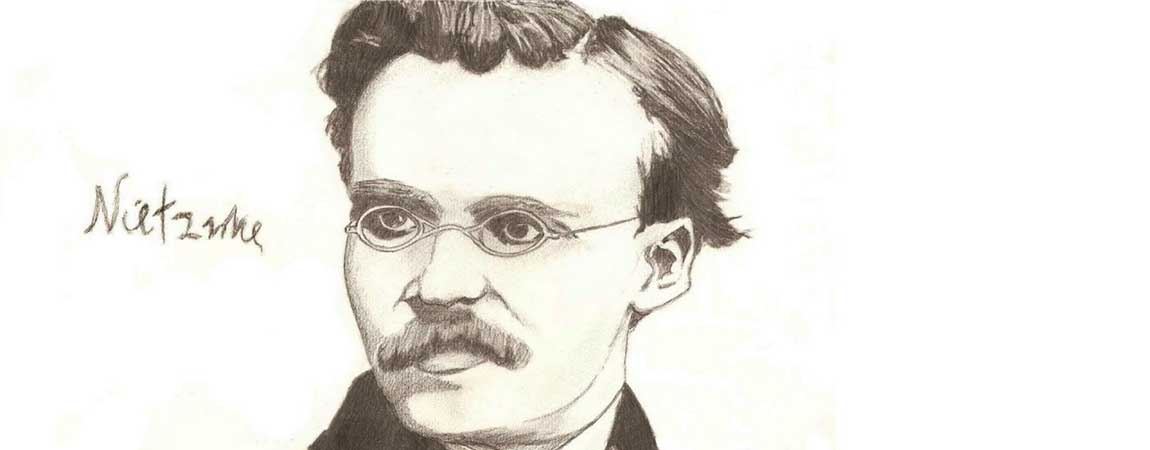
An ardent follower of Schopenhauer and lover of the ancient Greeks, the mustachioed Friedrich Wilhelm Nietzsche (1844-1900) is known, perhaps, to everyone. What did he represent? He was a German thinker already beyond the boundary of the Enlightenment era: it was bourgeois times, philistinism, laziness, and the decline of philosophy, science, and thought in general. Of course, decline only in comparison with the previous golden stage: the inertia of throwing off the shackles of Christianity gave the Western world a couple of centuries of scientific progress, but then exhausted itself, and completely different values came to the fore - money, success, stability, laziness, mediocrity. The last two are more of a typical exaggerated remark from Nietzsche than truth :)
Nietzsche was physically weak and ill from birth - an important detail that helps understand his passion for strength, sensuality, and power: just as the blind dream of seeing and the deaf dream of hearing. The central stone of his ideas was the binary opposition of activity and reactivity, power and powerlessness, morality and ethics, God and theology, masters and slaves. Nietzsche believed that the Christian religion was the root of evil: it propagates conformism, mercy, love, and everything that is convenient for the majority of people (who are essentially worthless slaves), and this religion prevents the people of Europe from throwing off the shackles of weakness and starting to live to the fullest. Nietzsche introduced the concept of the Übermensch (Superman) in opposition to the last man (in whom he saw the majority of his contemporaries with their stupidity, laziness, ignorance, philistinism, and pretense). As a prototype of the superman, Nietzsche named such people as Julius Caesar, Cesare Borgia, Napoleon, and other power-hungry madmen with an inferiority complex. Nietzsche despised morality and the moral values of society, subjected all ethics and the development of Western philosophy before him to serious criticism. By middle age, his constant physical ailments and illnesses resulted in various mental disorders and by the end of his life - almost complete paralysis.
I can say for myself that his criticism was justified and quite sharp, however, the poor fellow proposed a fundamentally wrong way of fighting the vices of society: carried away by mysticism and pagan worship of energy and strength, he proposed a radical rejection of society, a retreat to nature, while extolling that very "superman" (of whom, in terms of physiology and health, he himself was the antithesis) and placing him as master over a mass of slaves. "Push what is falling" - such was Nietzsche's morality. Although in reality, if one has strength, energy, and the ability to use them, why not try to bring as many people as possible to the same state, instead of destroying them? Unfortunately, quite sound and strong criticism of the state of affairs served up with the sauce of a sick person offended by everyone can seriously influence impressionable minds. Thus, Hitler was definitely fascinated by Nietzsche's ideas, and being weak in both mind and body, drew fundamentally wrong conclusions (Nietzsche himself, by the way, was against anti-Semitism).
Nevertheless, I highly recommend for familiarization: "Thus Spoke Zarathustra" and "Beyond Good and Evil". Though Friedrich calls everyone shit without discrimination, he dreams of important things, and these ideas are worth thinking through yourself during and after reading.
Quotes
Thus Spoke Zarathustra (1883-1885)
He who cannot obey himself will be commanded.
The time is approaching when the most contemptible man will arrive, who can no longer despise himself.
Beyond Good and Evil (1886)
The power of moral prejudices has penetrated deeply into the most intellectual world, the world apparently most indifferent and unprejudiced, and has obviously operated in an injurious, obstructive, blinding, and distorting manner.
One should not wrongly reify "cause" and "effect," as the natural scientists do (and whoever, like them, now "naturalizes" in his thinking), according to the prevailing mechanical doltishness which makes the cause press and push until it "effects" its end; one should use "cause" and "effect" only as pure concepts, that is to say, as conventional fictions for the purpose of designation and communication - not of explanation. In the "in-itself" there is nothing of "causal connections," of "necessity," or of "psychological non-freedom"; there the effect does not follow the cause, there is no rule of "law." It is we alone who have devised cause, sequence, for-each-other, relativity, constraint, number, law, freedom, motive, and purpose; and when we project and mix this symbol world into things as if it existed "in itself," we act once more as we have always acted - mythologically.