
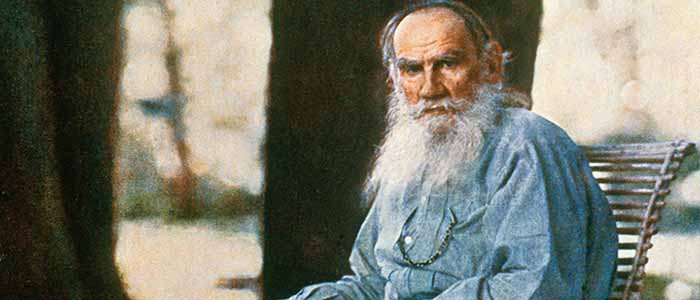
Since school days, whenever Tolstoy was mentioned, I always pictured endless thick volumes about the relationships of young people in high society of imperial Russia. Something like a reality show, only two centuries ago. And half the text - in French. Therefore, when I finally got around to War and Peace, my surprise knew no bounds! Tolstoy wrote in a rich, living language, a style completely different from the gloominess of Gorky and Dostoevsky. Colorful text that gives a sense of life and energy, into which you immerse yourself easily and without second thoughts, and then you're even glad that the volume is substantial - meaning you can keep reading without fearing the book will end soon.
Writer-thinkers and other philosophers and poets I divide into two categories - those who understood and found the meaning of life, and those who continued searching until the very end. Sometimes the latter became the former, but I've never encountered those who found happiness and then suddenly lost it again. I should immediately note that those who searched until the very end gave the world perhaps even more than the first category. I wouldn't want to place anyone higher or lower on an imaginary ladder of enlightenment or diminish anyone's merits. Nevertheless, Count Leo Nikolaevich Tolstoy certainly left me with the impression of a man who has got it. He understood, he found, he attained calm happiness and the peace of a person who has grasped something, found truth and meaning. Judging by his biography, I can well imagine that his happiness wasn't as magnificently joyful as Pushkin's happiness. However, he quite unambiguously describes his findings in the epic of War and Peace, and in several vivid episodes and examples:
- Prince Andrei, who fell from his horse and understood the meaninglessness of war, suddenly attaining a love so complete that it allowed him to forgive even his enemy. An analogy to Vajrayana Buddhism comes to mind - one of the branches of Buddhism that allows for instant enlightenment and, unlike Mahayana (the most widespread branch), extols departure into Nirvana from all worldly affairs. What happened to Andrei Bolkonsky was exactly that - instant enlightenment after falling from a horse followed by departure to "another" world, where he found true bliss.
- Pierre, who is, as I think, a prototype of Tolstoy himself, chose and embodied in life another path - the path of pure and light joy of the present moment, the happiness of freedom, primarily the happiness of awareness of freedom, which cannot exist until the past and future are cast aside and it is grasped that there is no other time but now. For me, the key moment on Pierre's path of becoming, and perhaps the key moment of the entire book, is the meeting with uncle Platon Karataev. It was this kind and "round" character who showed Pierre an alternative approach to life - when everything has a living essence, when the world is filled with tenderness, when simple kind things acquire primary meaning, when there is God. Through folk wisdom, Pierre was led to understand that happiness is in simple things, happiness is in the moment, happiness cannot go anywhere, and everything that happens is for the best.
Perhaps Tolstoy wanted to contrast these two characters, perhaps not. Either way, not only these two people live on the pages of the novel; absolutely everyone lives there. The writer's genius endows every chapter with soul. And also, it's incredibly captivating to read about historical events from the first person. As Hugo wrote about the French Revolution, Sholokhov about the Russian Revolution, so Tolstoy writes about those years, about the horrors and absurdities of war, about manners, about the life of high society, Moscow and St. Petersburg, and there is no source for me deeper and more detailed than such works by brilliant people.
Quotes
War and Peace (1865—1869)
Now he often recalled his conversation with Prince Andrei and completely agreed with him, only understanding Prince Andrei's thought somewhat differently. Prince Andrei thought and said that happiness is only negative, but he said it with a shade of bitterness and irony. As if, saying this, he was expressing another thought - that all the aspirations to positive happiness implanted in us were implanted only to torment us without being satisfied. But Pierre, without any ulterior motive, recognized the justice of this. The absence of suffering, the satisfaction of needs, and consequently the freedom to choose one's occupation, that is, one's way of life, now seemed to Pierre the undoubted and highest happiness of man. Here, now, for the first time, Pierre fully appreciated the enjoyment of eating when he wanted to eat, of drinking when he wanted to drink, of sleeping when he wanted to sleep, of warmth when he was cold, of talking with a person when he wanted to talk and hear a human voice. The satisfaction of needs - good food, cleanliness, freedom - now, when he was deprived of all this, seemed to Pierre perfect happiness, while the choice of occupation, that is, of life, now, when this choice was so limited, seemed to him such an easy matter that he forgot that the excess of the comforts of life destroys all the happiness of satisfying needs, and that the great freedom of choice of occupations, that freedom which in his life was given to him by education, wealth, and position in society - that this very freedom makes the choice of occupations insolubly difficult and destroys the very need and possibility of occupation.